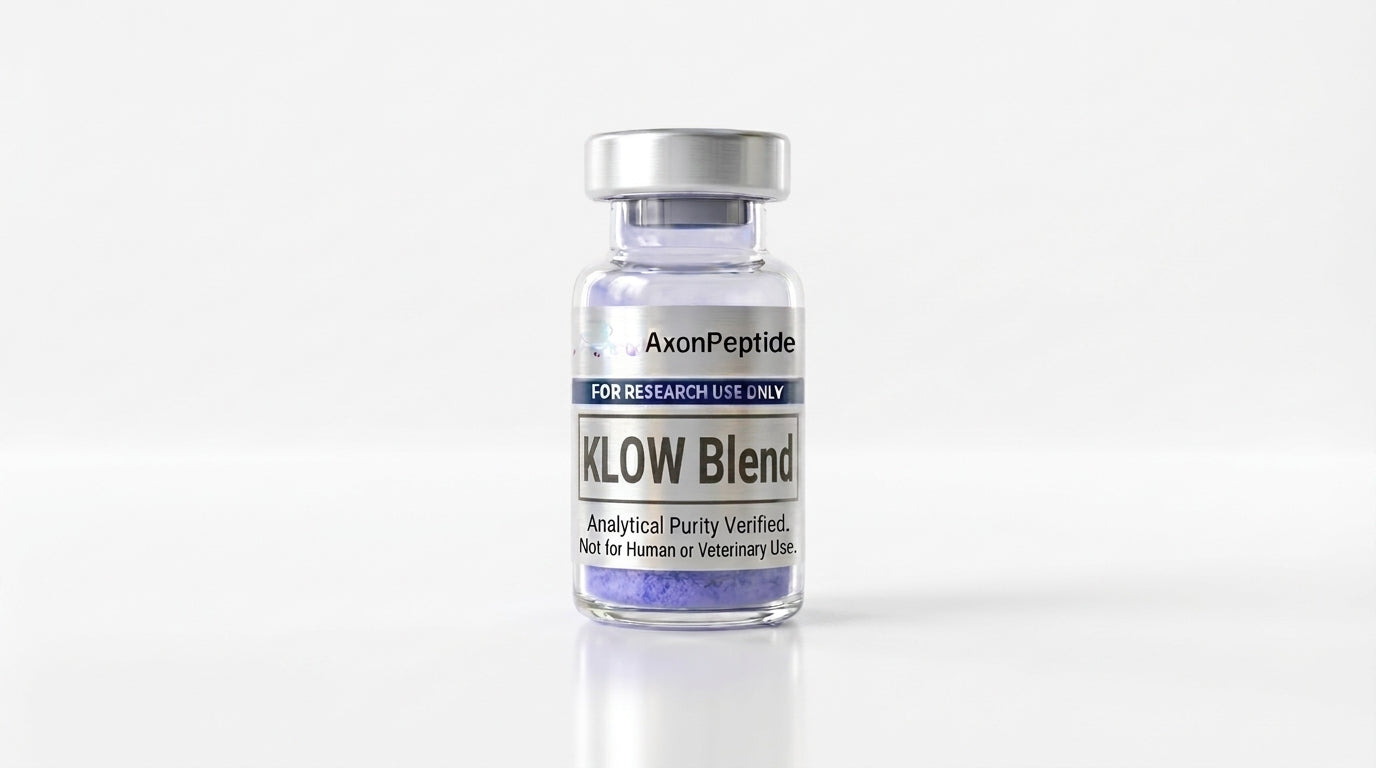
AXP-KLOW Blend
For research use only. Not for human or veterinary use.
Products sold by AxonPeptide are intended solely for laboratory research and analytical purposes. By purchasing, you confirm that you are at least 21 years of age and that the materials will be handled in accordance with applicable laws and regulations. Each lot is supported by verifiable analytical documentation and traceability records.
- Standard Shipping (USPS Ground Advantage) or Expedited (FedEx 2-Day) available at checkout (rates shown at checkout).
- Free 2-Day shipping on all orders over $200 (U.S. only).
- Order cutoff: Orders placed by 1:00 PM ET ship the same business day.
- Delivery times are estimates after shipment and may vary by location and carrier conditions.
- No shipping to PO Boxes.
Choose options

Peptide Name
KLOW (GHK-Cu + BPC-157 + TB-500 + KPV Blend)
Peptide Class
Synthetic peptide blend; copper(II) tripeptide complex (GHK-Cu) + cytoprotective peptide
fragment (BPC-157) + thymosin beta-4 analog (TB-500) + linear tripeptide (KPV)
Amino Acid Sequence
GHK-Cu: Gly-His-Lys coordinated with Cu²⁺
BPC-157: Gly-Glu-Pro-Pro-Pro-Gly-Lys-Pro-Ala-Asp-Asp-Ala-Gly-Leu-Val
TB-500: Sequence corresponding to thymosin beta-4 (43 amino acids)
KPV: Lys-Pro-Val
(exact sequences and blend ratio are provided on the lot-specific COA)
Molecular Formula
Reported on COA for each component
(elemental composition depends on copper coordination state, counter-ion form, and hydration)
Molecular Weight
GHK-Cu: ~403–405 g/mol (complex form)
BPC-157: ~1.42 kDa
TB-500: ~4.96 kDa
KPV: ~341.4 g/mol
Combined (approximate): ~7.1–7.2 kDa (non-covalent blend)
(exact values confirmed by MS and reported on COA)
Peptide Type
Blend of linear synthetic peptides; includes one metal-coordinated tripeptide and three linear peptides
Chemical Structure
Four independent components: (1) GHK tripeptide chelating Cu²⁺via histidine and backbonecoordination; (2) BPC-157 linear pentadecapeptide; (3) TB-500 linear thymosin beta-4 analog;(4) KPV linear tripeptide. Components are not covalently linked and are supplied as a physicalblend.
Solubility
Generally soluble in water and common aqueous laboratory buffers; apparent solubility mayvary with pH, ionic strength, peptide concentration, and copper coordination chemistry.
Stability Characteristics
Lyophilized form: Store dry, protected from light and moisture, at−20 °C or below for long-termstability.
Reconstituted solutions: Prepare under sterile conditions; store in aliquots at cold temperatures and minimize repeated freeze–thaw cycles. Stability is buffer- and pH-dependent for each component; copper coordination may influence solution behavior.
Source Classification
Synthetic (solid-phase peptide synthesis with controlled copper complexation for GHK-Cu)
Purity Specification
≥98% (HPLC or enzymatic assay)
Identity confirmed by assays
Batch-specific Certificate of Analysis (COA) available
Reconstituted solutions
Prepare under sterile conditions; store in aliquots at cold temperatures and minimize repeated freeze–thaw cycles. Stability is buffer- and pH-dependent for each component; copper coordination may influence solution behavior.
1. Pickart L et al. (2015). GHK-Cu and collagen remodeling in wound healing. Journal of Investigative Dermatology. https://www.jidonline.org/article/S0022-202X%2815%2940514-7/fulltext
2. Šikiric P et al. (2018). BPC-157 and inflammatory modulation in preclinical models. Current Pharmaceutical Design. https://repozitorij.kb-merkur.hr/islandora/object/kbmerkur%3A94
3. Siméon A et al. (2000). Anti-inflammatory properties of copper tripeptide in skin models. Inflammation Research. https://link.springer.com/article/10.1007/s00011-010-0214-4
4. Goldstein AL et al. (2012). Role of thymosin beta-4 in angiogenesis and tissue repair. Annals of the New York Academy of Sciences. https://link.springer.com/content/pdf/10.1007/s10456-007-9077-x.pdf
No COA record is currently linked to this product.
Molecular Details
Peptide Name
KLOW (GHK-Cu + BPC-157 + TB-500 + KPV Blend)
Peptide Class
Synthetic peptide blend; copper(II) tripeptide complex (GHK-Cu) + cytoprotective peptide
fragment (BPC-157) + thymosin beta-4 analog (TB-500) + linear tripeptide (KPV)
Amino Acid Sequence
GHK-Cu: Gly-His-Lys coordinated with Cu²⁺
BPC-157: Gly-Glu-Pro-Pro-Pro-Gly-Lys-Pro-Ala-Asp-Asp-Ala-Gly-Leu-Val
TB-500: Sequence corresponding to thymosin beta-4 (43 amino acids)
KPV: Lys-Pro-Val
(exact sequences and blend ratio are provided on the lot-specific COA)
Molecular Formula
Reported on COA for each component
(elemental composition depends on copper coordination state, counter-ion form, and hydration)
Molecular Weight
GHK-Cu: ~403–405 g/mol (complex form)
BPC-157: ~1.42 kDa
TB-500: ~4.96 kDa
KPV: ~341.4 g/mol
Combined (approximate): ~7.1–7.2 kDa (non-covalent blend)
(exact values confirmed by MS and reported on COA)
Peptide Type
Blend of linear synthetic peptides; includes one metal-coordinated tripeptide and three linear peptides
Chemical Structure
Four independent components: (1) GHK tripeptide chelating Cu²⁺via histidine and backbonecoordination; (2) BPC-157 linear pentadecapeptide; (3) TB-500 linear thymosin beta-4 analog;(4) KPV linear tripeptide. Components are not covalently linked and are supplied as a physicalblend.
Solubility
Generally soluble in water and common aqueous laboratory buffers; apparent solubility mayvary with pH, ionic strength, peptide concentration, and copper coordination chemistry.
Stability Characteristics
Lyophilized form: Store dry, protected from light and moisture, at−20 °C or below for long-termstability.
Reconstituted solutions: Prepare under sterile conditions; store in aliquots at cold temperatures and minimize repeated freeze–thaw cycles. Stability is buffer- and pH-dependent for each component; copper coordination may influence solution behavior.
Source Classification
Synthetic (solid-phase peptide synthesis with controlled copper complexation for GHK-Cu)
Purity Specification
≥98% (HPLC or enzymatic assay)
Identity confirmed by assays
Batch-specific Certificate of Analysis (COA) available
Reconstituted solutions
Prepare under sterile conditions; store in aliquots at cold temperatures and minimize repeated freeze–thaw cycles. Stability is buffer- and pH-dependent for each component; copper coordination may influence solution behavior.
References
1. Pickart L et al. (2015). GHK-Cu and collagen remodeling in wound healing. Journal of Investigative Dermatology. https://www.jidonline.org/article/S0022-202X%2815%2940514-7/fulltext
2. Šikiric P et al. (2018). BPC-157 and inflammatory modulation in preclinical models. Current Pharmaceutical Design. https://repozitorij.kb-merkur.hr/islandora/object/kbmerkur%3A94
3. Siméon A et al. (2000). Anti-inflammatory properties of copper tripeptide in skin models. Inflammation Research. https://link.springer.com/article/10.1007/s00011-010-0214-4
4. Goldstein AL et al. (2012). Role of thymosin beta-4 in angiogenesis and tissue repair. Annals of the New York Academy of Sciences. https://link.springer.com/content/pdf/10.1007/s10456-007-9077-x.pdf
COA
No COA record is currently linked to this product.